


Ethiopia - 2018
Between 2015 and 2020, Ethiopia stood at a crossroads between a deeply rooted cultural past and a rapidly changing future.
One of Africa’s most culturally diverse countries, it is home to more than eighty ethnic groups and a wide range of religious traditions, languages and ways of life. From the highlands to the southern lowlands, this diversity has long been part of the country’s identity, while Ethiopia has also emerged as one of the continent’s most important promises of economic and regional development.
New roads, industries, agricultural projects and infrastructure were reshaping the country, bringing new opportunities while also placing pressure on communities whose lives remained closely connected to the land.


In the Omo River Valley, this tension was particularly visible. The region is home to communities such as the Hamer, Mursi and Karo, whose traditions have developed around the river, seasonal agriculture and pastoralism.
Body painting, elaborate ornaments, scarification and ceremonies remain important expressions of identity, even as roads, tourism, large-scale agriculture and dams increasingly penetrate the region.
For these communities, the changes were not simply economic. The transformation of the river and surrounding land threatened a way of life that had been passed from one generation to another, forcing people to negotiate between ancestral customs and an increasingly modern Ethiopia.


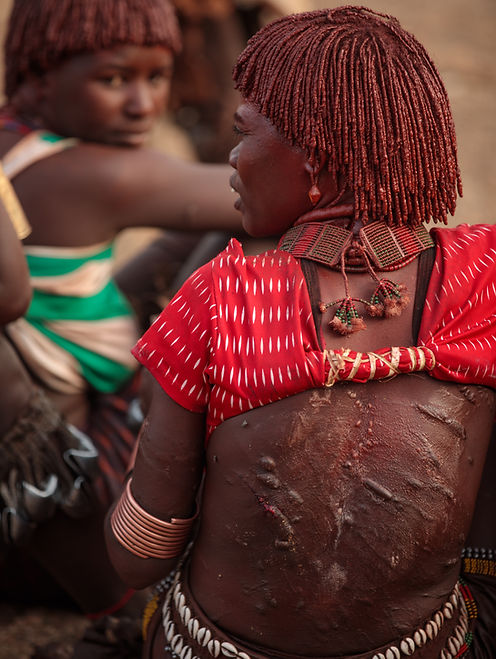
Among the Hamer, the Bull Jumping ceremony remains one of the most important expressions of this cultural continuity.
The ritual marks a young man’s passage into adulthood and is accompanied by days of celebration, dancing, singing and elaborate forms of body decoration. During the ceremony, the initiate must successfully run across the backs of a line of cattle, a test that carries profound social meaning for him and his family.
Another part of the tradition consist in women related to the young man undergoing the initiation challenge the men to whip them with thin branches. The blows leave deep cuts and permanent scars across their backs and arms. Enduring the pain without retreating is traditionally associated with courage, strength and loyalty to the community. The scars themselves can become lasting marks of pride and belonging.
Beyond its spectacular appearance, the ritual reveals how social relationships, marriage, status and identity remain connected to traditions that have survived generations of change.


Religion provides another expression of Ethiopia’s extraordinary diversity. In the northern regions around Gondar and Lalibela, Christian Orthodoxy has shaped architecture, politics and daily life for centuries, while Islam has an equally long and significant history across the country.
The two traditions coexist within a broader Ethiopian society in which religious identity is often closely intertwined with local customs, history and community life. In Gondar, churches and monasteries stand alongside Muslim communities and historic Islamic sites, reflecting the layers of culture that have accumulated across northern Ethiopia.
Lalibela is perhaps the most remarkable expression of this Christian heritage. Often described as the African Jerusalem, the city is home to a group of churches carved directly into the rock between the 12th and 13th centuries. Rather than being built on top of the landscape, the churches were excavated downward into the volcanic stone, creating courtyards, tunnels and sanctuaries beneath the surface. They remain active places of worship and pilgrimage, connecting contemporary Ethiopia to a medieval Christian tradition that continues to define much of the country’s cultural identity.


